

Competition in the American watch market is no longer only about the best-known names or the references everyone recognises. At the 11th edition of WatchTime New York, which opened on 16 October in Manhattan, 48 brands are taking part — the largest line-up in the event's history — including 11 first-time exhibitors. Yet the organisers' comments point to a shift more significant than a growing exhibitor list: a segment of American collectors is now looking for less conventional watches, and for the people behind them, not just the name on the dial.
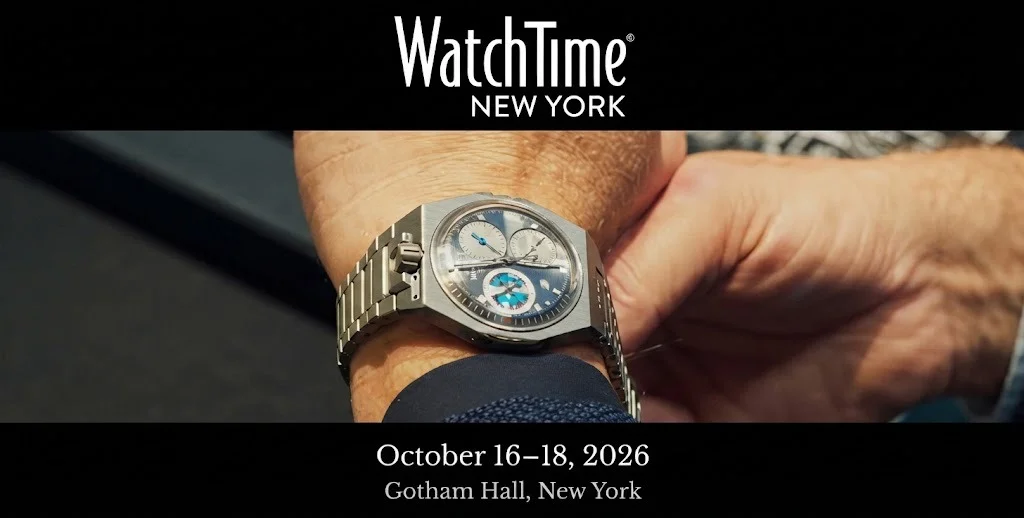
The 2026 edition runs at Gotham Hall from 16 to 18 October, bringing together major houses and independent watchmakers, with global launches and several watches shown for the first time. Exhibitors include Blancpain, Chopard, Piaget and Zenith, alongside independents such as MB&F, Urwerk, Kari Voutilainen, Laurent Ferrier, Ressence and Czapek. WatchTime describes the event as a chance for collectors to see watches that are usually hard to access, and to talk directly with the founders, watchmakers and people responsible for developing them.
11 new brands in a 48-name edition
Sara Orlando, publisher of WatchTime, says this year's edition welcomes 11 new brands, taking the total to a record 48 exhibitors. Newcomers include Gérald Genta, Daniel Roth, Jacob & Co., Kollokium, Keris, Ferdinand Berthoud, Singer Reimagined, Schwarz Etienne and Kudoke, along with new releases, some of them unveiled to the public for the first time.
Notably, the show's growth is not driven by the big houses alone. WatchTime announced 46 brands in August, and the number rose to 48 as opening day approached, while independent watchmaking has become a clear part of the event's identity rather than a small corner beside the traditional names.
The American collector wants a watch they don't see on every wrist
Speaking to FashionUnited, Orlando offered a direct explanation for the growing interest in independents. Based on what she has observed at the show, some American collectors are no longer excited by the idea of wearing the same watch they see on everyone else, and are increasingly drawn to unusual dials and movements that offer solutions and designs outside the mainstream.
This is not the result of a statistical survey of the US market, but a reading based on the organisers' experience and direct contact with collectors, so it cannot be applied to every buyer in the United States. It does, however, match the exhibitor list itself, which this year includes many brands that built their standing on unconventional ways of displaying time, or on limited production and movements and designs with a strong personality.
Ressence, for example, built its language around a rotating display that departs from traditional hands; Urwerk has spent years developing unusual systems for reading the time; and MB&F creates mechanical pieces that feel closer to moving works of engineering than to a conventional watch. Having these names under one roof lets collectors compare schools of thought that share little beyond their rejection of the conventional solution.
The person who made the watch is now part of its value
The second shift Orlando points to concerns what collectors are actually buying. In her experience, some clients' interest no longer stops at the watch or the company logo; it extends to the people behind the brand. As she puts it, collectors are now investing in the people behind these projects, too.
This matters especially for independent watches, where the founder may also be the designer, the watchmaker, or the person who explains to the client how the idea came about and why a particular mechanism was chosen. The relationship is different from buying a product from a large global group, because the maker's story, career and way of working can become part of the decision to collect.
That is why the WatchTime New York programme focuses on having these people present in person. The 2026 guest list includes founders, watchmakers and executives meeting collectors directly on the show floor, and WatchTime describes these conversations as a chance to understand how a watch was developed and the decisions that shaped its final form.
The show tries to remove the barrier between maker and collector
Mynda Larsen, director of WatchTime New York, says one of her goals since founding the event has been for visitors to feel they can approach and ask questions without feeling intimidated. She links this to what she describes as the American audience's curiosity and eagerness to learn when they encounter a brand or watch they don't know, which is why she has tried to build a more welcoming, less formal show than the traditional image of some luxury watch events.
The approach sounds simple, but it addresses a real problem in an industry built on products that can cost tens or hundreds of thousands of dollars. A very formal setting can make a newcomer hesitant to approach or to ask a question they consider basic, while independent brands in particular depend on explaining their story and their idea, because many clients have never heard of them before.
So the organisers do not measure the experience by the size of the booths or the hospitality on offer; they stress that the collector is the event's core audience. That is an important distinction between a trade fair centred on relationships between brands and retailers, and an open event built so that the person who might buy a watch can meet the person who made it or represents it.
Even the choice of brands is shaped by collectors
Larsen says audience feedback is not simply gathered after the show and filed in an internal report; it feeds into decisions about the next edition, from which brands are invited to ticket prices, panel topics and even some details of the on-site experience.
Here the collector becomes not just a recipient of the programme but a party that helps shape it. If demand for independents grows, or there is a wish to meet particular names, the show can adjust its line-up and programme accordingly — which may partly explain why the independent presence has expanded year after year.
The model differs from traditional trade fairs, where access was historically tied to the press, retailers and distributors. WatchTime New York began at a time when closed-door events were more common in the watch industry, yet chose from the outset to focus on collectors and the public — a direction that has since become more visible at other events around the world.
From Geneva to Riyadh and New York: the watch fair is no longer just a place for launches
What is happening in New York is part of a wider change in the watch industry. In Geneva, face-to-face meetings with independents have become a core element of Geneva Watch Days, while Timeology Nights in Riyadh tested a model that brings brands, watchmakers and collectors together in one space, with talks, workshops and editions developed for the local market.
The difference is that each city builds the model in its own way. WatchTime New York clearly leans into a less formal, American character, and presents itself as an event for collectors rather than a direct rival to Europe's larger fairs. Orlando herself says the current aim is to complement an event like Watches and Wonders, not replace it, by offering an experience more focused on consumers and collectors.
The result is that the value of a watch fair is no longer tied to being the only place to see a new release; images, specifications and prices reach the public online the moment they are announced. What is hard to transfer to a screen is the chance for a collector to hold the watch, talk to its maker and understand why it was designed this way before deciding whether it deserves a place in their collection.
Independents benefit most from this relationship
For a global house with a vast retail network, a fair remains an important channel, but it is not the only way clients can reach its products. The situation is different for many independents, who produce small numbers and have no physical presence in dozens of cities.
Orlando says WatchTime New York has, over the years, helped some brands enter the American market, while giving collectors the chance to see artisanal watches they might not otherwise have been able to access. This explains why the independent presence has become one of the elements the organisers are proudest of.
So their growing numbers reflect not only the market's appetite for different products, but also a change in how collectors discover a new brand. Instead of the relationship starting with an advert or a boutique, it may begin with a conversation with the maker — and the watch comes after.
Has the American collector's taste really changed?
What the WatchTime New York organisers say is a strong signal, but on its own it is not enough to declare a sweeping shift in the American market. Their remarks are not based on a representative study of all watch collectors, or on sales data comparing independents with the major houses, and the show itself naturally attracts a more watch-literate audience than the average buyer.
What can clearly be observed, though, is a change in the environment surrounding collecting. Forty-eight brands are taking part this year, 11 of them for the first time; independents have become a central part of the line-up; and the organisers are building the programme around collectors meeting the people who made the watches, rather than simply displaying them behind glass.
This may be the most important shift in the WatchTime New York story. A different watch attracts attention, but knowing who made it and why they made it that way has become an increasingly important part of the experience. If the trend continues, competition in the collecting market will not be between products alone, but between the stories, people and ideas behind them as well.
Comments
No comments yet.