
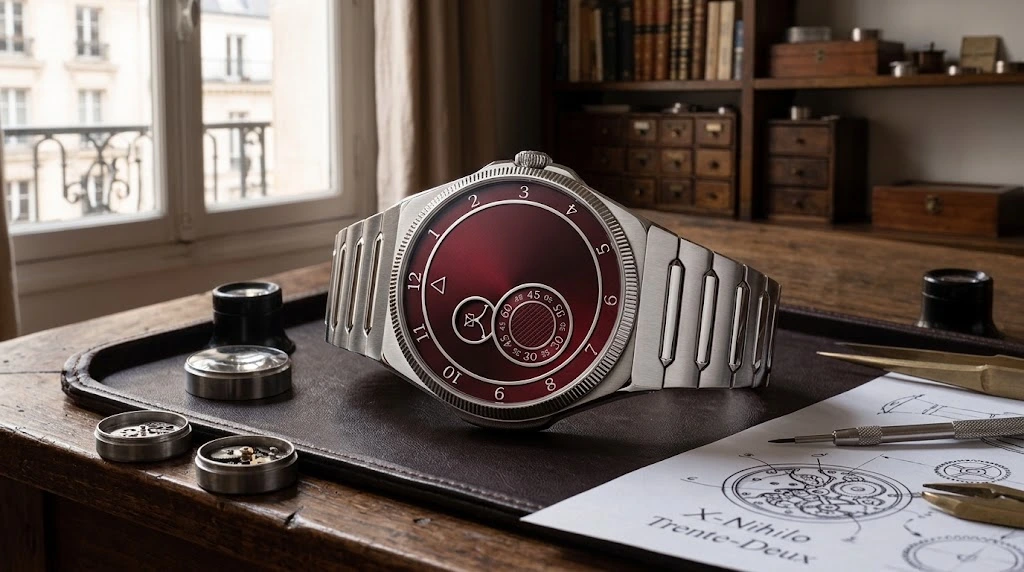
Instead of hands sweeping across a stationary dial, the "Trilobe Château Trente-Deux" does almost the exact opposite: the numerals themselves rotate across three separate rings for the hours, minutes, and seconds, while the indicator points remain static. This is the foundational concept upon which the French brand Trilobe built its identity from the very beginning. However, the new watch marks an even greater turning point in the company's history, as it is driven by the "X-Nihilo" caliber—a movement the maison states was designed, developed, manufactured, decorated, and assembled in-house within its Parisian facilities, marking its first proprietary manufacture caliber.
Trilobe unveiled the "Château Trente-Deux" edition on September 2, 2026, before the watch regained renewed attention throughout October with the release of fresh reviews and hands-on impressions. Thus, it is not an October 20 launch, but rather a recent release currently receiving a second wave of coverage. The new edition features a deep red dial inspired by the tones of aged vintage wine. Buyers of the first 100 units will receive a bespoke caseback engraving alongside a bottle of French "Grand Cru" selected by the maison, after which the watch will continue as part of the permanent collection without this pairing. How Do You Read a Watch Without Hands?
The fundamental distinction of the "Château Trente-Deux" is neither its colorway nor its bracelet, but rather the way it indicates time. The watch utilizes three independent rotating elements set flush with the dial surface, representing the hours, minutes, and seconds. The numerals themselves revolve until they align with fixed markers indicating the current time. Patented by Trilobe, this approach is virtually the inversion of conventional horological architecture, where the dial remains fixed while hands sweep over it.
This configuration does not necessarily make telling time faster; in fact, the wearer requires a brief adjustment period to become accustomed to it, which is fundamentally part of the concept. The brand is not striving to engineer a device that tells time more efficiently than a smartphone or a standard timepiece, but rather to transform our visual relationship with time itself—making the dial continuously dynamic rather than a passive backdrop. Trilobe describes its philosophy as liberating time from conventional form, a vision manifested far more vividly across this collection than through any decorative embellishment. "Trente-Deux" Is More Than Just a Number
The name "Trente-Deux"—French for 32—traces back to the address of the brand’s Parisian workshop, and also served as the project’s internal codename during the development of both the collection and its caliber. The family debuted in 2025 as Trilobe's first line pairing an in-house manufacture movement with an integrated metal bracelet, ahead of additional iterations introduced throughout 2026.
According to the company, developing the "X-Nihilo" movement required three years of research and development, while the integrated bracelet went through approximately 120 sketches before reaching its final form. These details illustrate why the "Trente-Deux" represents a pivotal milestone for a brand established only in 2018. Prior to this line, Trilobe was primarily known for its unconventional time displays; now, it seeks to anchor its identity with greater vertical integration and mastery over movement manufacturing. Trilobe's First Manufacture Movement
The automatic "X-Nihilo" movement comprises 218 components and 34 functional jewels, operating at a frequency of 4 Hz (28,800 vibrations per hour) with a 42-hour power reserve. It measures 35.2 mm in diameter and 7 mm in thickness, displayed openly through a sapphire crystal caseback.
However, the caliber's chief significance for Trilobe extends beyond its raw specifications—a 42-hour power reserve and a 4 Hz beat rate are hardly anomalous in modern horology. Rather, the true significance is the brand’s progression away from third-party mechanisms toward an engine conceived, engineered, and executed within its own Parisian ecosystem. The company emphasizes that the design, prototyping, machining, finishing, and assembly phases are all handled in-house, supported by a precision micromechanics production facility near Paris.
The movement employs an architecture that carves out negative space around the balance wheel to emphasize it visually. Finishing highlights include fine and coarse bead-blasting on the bridges and mainplate, black-polished screw heads, hand-applied satin brushing on the bridge surfaces, circular graining on the gear train, and a sunburst finish radiating across the winding rotor. Paris Seeks to Reclaim a Share of Watchmaking
This dimension elevates the watch beyond a standalone consumer product. Historically, Paris served as a major cradle of European horology before the industry's center of gravity shifted almost exclusively to Switzerland over the past two centuries. Today, Trilobe’s workshop is nestled in the Opéra district, in close proximity to Place Vendôme and the Palais-Royal—a neighborhood once populated by legendary French clockmakers such as Le Roy, Berthoud, and Lepaute.
This does not imply that France has abruptly reclaimed horological supremacy from Switzerland, nor that Trilobe has transformed into a massive industrial manufacture. Nonetheless, the new caliber represents a vital step for an independent brand determined to link its provenance to Paris not merely via design and marketing, but through tangible production. This places the "Château Trente-Deux" within a broader movement of French watchmakers working to restore domestic technical infrastructure rather than settling for encasing catalog Swiss calibers in French styling. Seven Components in a Single Case
The watch is presented in a 316L stainless steel case measuring 39.5 mm in diameter, 10.15 mm in thickness, and 46.18 mm lug-to-lug. Constructed from seven distinct components, the case marries polished, satin-brushed, and sandblasted finishes, flanked by a fluted bezel that alternates between mirror-polished and matte surfaces. Water resistance is rated to 50 meters.
Flowing from the case is an integrated steel bracelet secured by a double-folding deployant clasp, with an optional rubber strap also available. Trilobe approached the bracelet as an organic component of the overall geometry rather than an aftermarket addition; its links taper gradually toward the clasp, displaying satin surfaces, polished chamfers, and mirror-finished interior link facets. A New Hue That Leaves the Mechanics Untouched
Mechanically, the "Château Trente-Deux" does not introduce a new caliber relative to earlier variants in the collection, nor does it incorporate added complications. The primary distinction resides in the deep red dial and the narrative bridge the maison has built to French viniculture. It would therefore be an overstatement to characterize it as a new mechanical innovation of 2026; the genuine mechanical milestone occurred with the initial launch of the "Trente-Deux" and the "X-Nihilo" caliber in 2025.
The dial itself features a matte sunray finish complemented by frosted rings for the hours and minutes, while the running seconds disc combines circular satin-brushing with a Clous de Paris hobnail motif. Enclosing these elements is a concentric track alternating between satin and mirror finishes—fine touches calibrated to impart visual depth to a dial face that deliberately foregoes traditional hands to generate kinetic motion. Why Pair a Bottle with a Timepiece?
Trilobe chose to associate this new edition with the maturation of time inherent to fine winemaking. Consequently, only the first 100 units will come accompanied by a curated bottle of French Grand Cru chosen by the maison, alongside a dedicated caseback engraving. Once these initial units are spoken for, the "Château Trente-Deux" will remain available as part of the core catalog, without the production run being capped at 100 pieces. This distinction is critical, as several media outlets mistakenly categorized the release as a strict 100-piece limited edition.
The association with wine remains fundamentally an evocative marketing narrative rather than a technical horological attribute, altering nothing within the movement or its tolerances. Instead, it employs the abstract concept of "time" as an artistic bridge between two distinct French artisanal heritage crafts. It is best evaluated within those parameters, rather than as a technical merit of the watch. €17,500 Excluding Taxes
Trilobe officially retails the timepiece at €17,500 before taxes, as listed on its European online boutique. Factoring in French VAT, the price climbs to approximately €21,000, explaining why figures vary across differing global publications.
This price bracket places the watch squarely within a contested segment populated by leading independent ateliers and heritage Swiss manufactures. Consequently, Trilobe cannot rest solely on the eccentric charm of a handless display. The true commercial proposition relies on a collector who appreciates the synergy of design originality, an in-house caliber, and the romantic value of reviving Parisian watchmaking, rather than one solely cross-referencing specification sheets against established competitors at the same price tier. The Concept Outweighs the "Grand Cru" Bottle
It is easy for the "Château Trente-Deux" to be summarized merely as a lighthearted headline about a luxury watch packaged with a bottle of wine, but doing so leaves the most substantive part of the story in the dark. Trilobe did not start innovating handless displays in 2026—it built its entire brand DNA around that premise—nor did it engineer this caliber specifically for this singular dial variant. Rather, in the roughly seven years since its founding, the independent maison has reached the threshold of producing the caliber that powers its philosophical vision, rather than settling for an unconventional dial atop an off-the-shelf engine.
This is what makes the "Château Trente-Deux" far more compelling than just another red dial variant. The numerals orbit while the markers remain still, the 218-part caliber is manufactured within the brand's own Parisian network, and the model enters regular production rather than disappearing after the first 100 examples. The Grand Cru bottle may be the easiest detail to remember, but it is undoubtedly the least consequential accomplishment Trilobe has realized here.
Comments
No comments yet.