
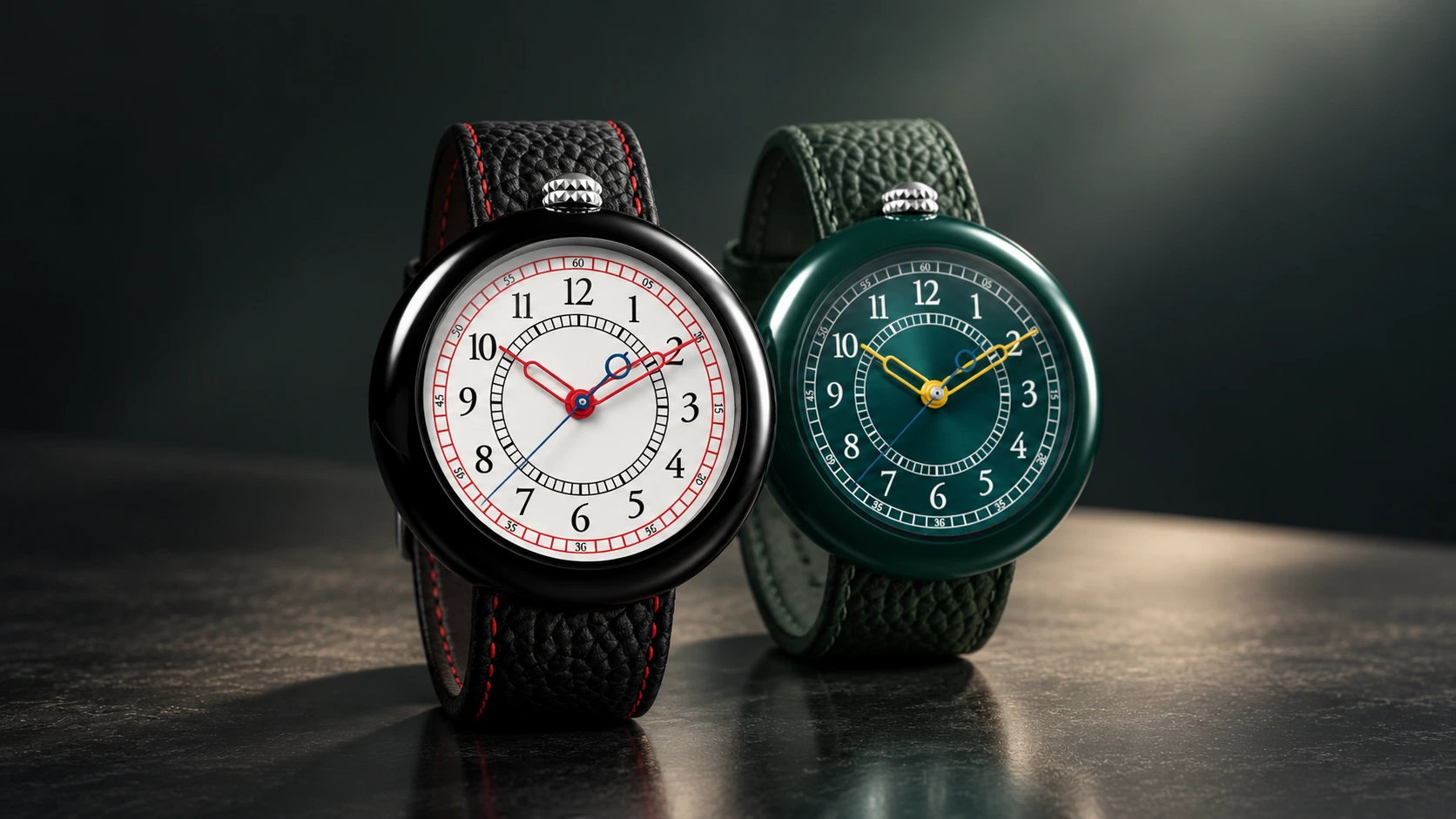
Before «Tambour» became the most recognizable face of «Louis Vuitton» watchmaking, the French fashion house had entered the world of wristwatches with an entirely different experiment in 1988, when it enlisted Italian architect and designer «Gae Aulenti» to create the «LV I» and «LV II». The watches featured rounded, pebble-shaped cases without traditional lugs and crowns positioned at 12 o’clock. Now, 38 years later, the concept returns to the house’s permanent collection through the «Louis Vuitton Monterey», available in black and green ceramic versions. The most significant difference, however, lies inside, where the original quartz movement has been replaced by an automatic mechanical movement developed by «La Fabrique du Temps Louis Vuitton».
The two new watches debuted in autumn 2026, but a hands-on review published by «Fratello» on October 19 brought renewed attention to one of the most unusual designs in «Louis Vuitton» history. The case measures 37mm in diameter, matching the dimensions of the original ceramic «LV II» from 1988. Both new versions join the house’s permanent collection rather than being released as limited editions, with an official US retail price of $22,900.
14 Years Before «Tambour»
It is easy to associate the history of «Louis Vuitton» watches with the introduction of «Tambour» in 2002, but that was not the true beginning. In 1988, the house introduced its first two wristwatches, the «LV I» and «LV II», in collaboration with Italian architect «Gae Aulenti», whose work also included transforming the former «Gare d’Orsay» railway station in Paris into the «Musée d’Orsay». «IWC» handled the industrial side of the project at the time, while both watches featured quartz movements and designs that largely departed from the conventional styling of 1980s timepieces.
The «LV I» was the larger and more complicated model, featuring an approximately 40mm gold case and functions including world time, moon phases, date, and alarm. The «LV II», meanwhile, came in a smaller 37mm case made from black or green ceramic, with date and alarm functions. Specialist sources indicate that approximately 4,000 examples of the «LV II» were produced, making it the direct inspiration for the two new 2026 versions.
The design itself was highly unconventional. The case resembled a polished pebble without protruding lugs, while the crown sat at 12 o’clock, much like certain pocket watches. The strap passed beneath the case through an attachment system integrated into the caseback, making the watch body appear visually separate from the strap. «Louis Vuitton» has preserved these elements in the modern version rather than redesigning the watch in a more conventional form.
The Revival Began With Gold Before Ceramic
«Louis Vuitton» did not wait until 2026 to revive the name. In 2025, the house introduced a new «Monterey» featuring a 39mm yellow-gold case and a «Grand Feu» enamel dial, in a limited edition of 188 pieces. The watch was closer in spirit to a reinterpretation of the «LV I». It already incorporated the mechanical «LFT MA01.02» movement, beginning the process of transferring the historic design from the world of quartz into modern mechanical watchmaking.
The two 2026 versions, however, return more directly to the «LV II». The house has revived the black and green ceramic colors associated with the original watch, maintained the 37mm diameter, and preserved the case shape, top-mounted crown, and strap concealed beneath the case. However, the alarm and date functions found in the 1988 model have not returned. Instead, the new watches display only hours, minutes, and seconds.
This reveals an interesting paradox in the revival of vintage watches. The new edition is more mechanically sophisticated but simpler in functionality. «Louis Vuitton» has abandoned practical complications that existed in the technically less expensive version 38 years ago, favoring a mechanical movement, finishing, and materials more closely associated with contemporary luxury watchmaking.
Ceramic Is Not Formed in a Conventional Mold
At first glance, the case may appear to be the simplest component of the watch, but its manufacturing process involves a notable technical dimension. According to the hands-on review published by «Fratello», «Louis Vuitton» does not form the ceramic directly inside a final mold. Instead, the process begins with a mixture of zirconium oxide-based ceramic powder and pigments, which is first compressed into a solid block. This block is then machined using a three-axis milling machine to create the case’s distinctive curves.
The component subsequently undergoes a sintering process at approximately 1,000 degrees Celsius to achieve its final hardness and color, followed by grinding, finishing, and hand polishing. The result is a highly polished surface in both the black and green versions, preserving the continuous rounded form that makes the watch appear more like a single polished object than an assembly of components constructed in the conventional manner.
«Louis Vuitton» lists the official case thickness at 12.1mm, excluding the crystal, with an anti-reflective sapphire crystal and water resistance of just 30 meters. These specifications confirm that the watch does not attempt to present itself as a sports timepiece despite its use of ceramic. Instead, it is a design-oriented watch intended for everyday wear and visual presence.
Green Preserves the Spirit of the 1980s While Black Enhances Contrast
The first version features a green case, dial, and strap, complemented by yellow hour and minute hands and a blue seconds hand. The second version uses a highly polished black case with a matte white dial, red hour and minute hands, and a blue seconds hand, along with red stitching on the black strap. Both versions retain the two circular minute tracks that give the dial an appearance reminiscent of technical instruments and drawings from the 1980s.
The colors are not achieved through a single simple coating. Instead, the dial is constructed using several layers of paint before receiving a final matte coating, while the numerals and tracks are applied through acrylic printing. Specialist reviews of the process indicate that each printing stage is followed by a separate heating cycle. If cracking or misalignment occurs in any layer, the dial cannot simply be corrected; the entire process must begin again.
These details matter because the modern «Monterey» does not rely on visible dial complications to justify its position within the luxury watch segment. Instead, it emphasizes the quality of its materials and the manufacturing processes used for the case, dial, and internal movement. These elements may appear visually simple, but they require relatively extensive manufacturing and finishing processes.
A Mechanical Movement Replaces Quartz
The fundamental transformation is found behind the closed steel caseback, where the automatic «LFT MA01.02» movement developed by «La Fabrique du Temps Louis Vuitton» powers the watch. The movement measures 23mm in diameter and 5.4mm in thickness, comprises 174 components and 26 jewels, and operates at a frequency of 28,800 vibrations per hour, with a 45-hour power reserve.
The movement uses an 18-karat rose-gold winding rotor decorated with patterns and the «LV» logo. Although the owner cannot see it because of the closed caseback, the house has not left the movement unfinished. It features circular decoration on the mainplate, sandblasted bridges, and finely finished edges.
This movement is the defining feature that clearly separates the new «Monterey» from the watch that inspired it. The original version emerged during a period in the 1980s when quartz movements had become a natural part of even luxury watches. The modern revival, by contrast, arrives in a market that once again places fundamental value on mechanical movements, even when a watch offers fewer functions than its predecessor.
Why Did «Louis Vuitton» Remove the Alarm and Date?
It would theoretically have been possible to redevelop the alarm and date functions that distinguished the original «LV II», but «Louis Vuitton» chose a more minimalist dial displaying only the time. This decision places «Gae Aulenti»’s design itself at the center of attention rather than its functions. The house describes the new version as a reinterpretation of the original watch’s design codes rather than a literal reproduction, a distinction that explains why the designers retained the case, colors, crown, and minute tracks while abandoning some of the original functions.
The transition from quartz to a mechanical movement has also increased the watch’s thickness compared with the original. This is one of those cases where faithfully reproducing a historic watch becomes less important than adapting it to the technical language currently embraced by the brand.
A Name That Probably Originated From a Mispronunciation
Even the name «Monterey» has an unusual story. The original watches were known as «Montre I» and «Montre II», with the French word «montre» meaning “watch.” However, according to an account widely circulated in specialist sources, the pronunciation of the name by some English speakers gradually evolved into «Monterey». Over time, the nickname became established among collectors and is now the official name used by «Louis Vuitton» itself.
The house does not present this story as a technical reason for reviving the watch, but it captures something of its character. The design remained on the sidelines for decades compared with «Tambour», before attracting the attention of collectors and eventually being officially reintroduced by the company into its collection.
A Permanent Return Rather Than an Exercise in Scarcity
The most important distinction between the 2026 release and the 2025 revival is that the two new watches are not limited to a specific production number. Instead, «Monterey» has become part of the permanent «Louis Vuitton» collection. This decision carries greater significance than producing a small commemorative edition because it indicates that the house does not regard the 1988 design merely as an archival piece to celebrate before returning it to storage. Rather, it sees the design as a watch family capable of continuing alongside its modern collections.
The official price in the US market is $22,900, while local prices vary depending on taxes and markets. Both the black and green versions carry the same price. At this level, «Monterey» enters a segment where it competes with mechanical watches from specialist watchmaking houses with longer histories in the industry. This makes design, heritage, and execution quality decisive factors in persuading buyers, rather than simply the presence of the «Louis Vuitton» logo on the dial.
A Watch From 1988 That Looks More Contemporary Today
Perhaps the most compelling explanation for the return of «Monterey» is that a design considered unusual in 1988 is now more closely aligned with the contemporary watch market. Smaller case sizes have made a comeback, ceramic has become a familiar material in luxury watchmaking, and lugless cases and unconventional geometric designs are no longer the marginal concepts they were almost four decades ago.
For this reason, the new «Louis Vuitton Monterey» appears less like an attempt to manufacture nostalgia for the 1980s and more like a belated rediscovery of a design that was ahead of its time. The house has retained the 37mm case, ceramic construction, crown at 12 o’clock, and bold colors, while completely replacing the watch’s mechanical heart. In doing so, it has transformed a quartz watch with an alarm and date into a mechanical timepiece that is simpler in function but more ambitious in its materials and finishing.
After 38 years, perhaps the most significant paradox is that «Louis Vuitton» did not need to redesign «Monterey» to make it look modern. It simply needed to reconsider the design it had already possessed since 1988.
Comments
No comments yet.