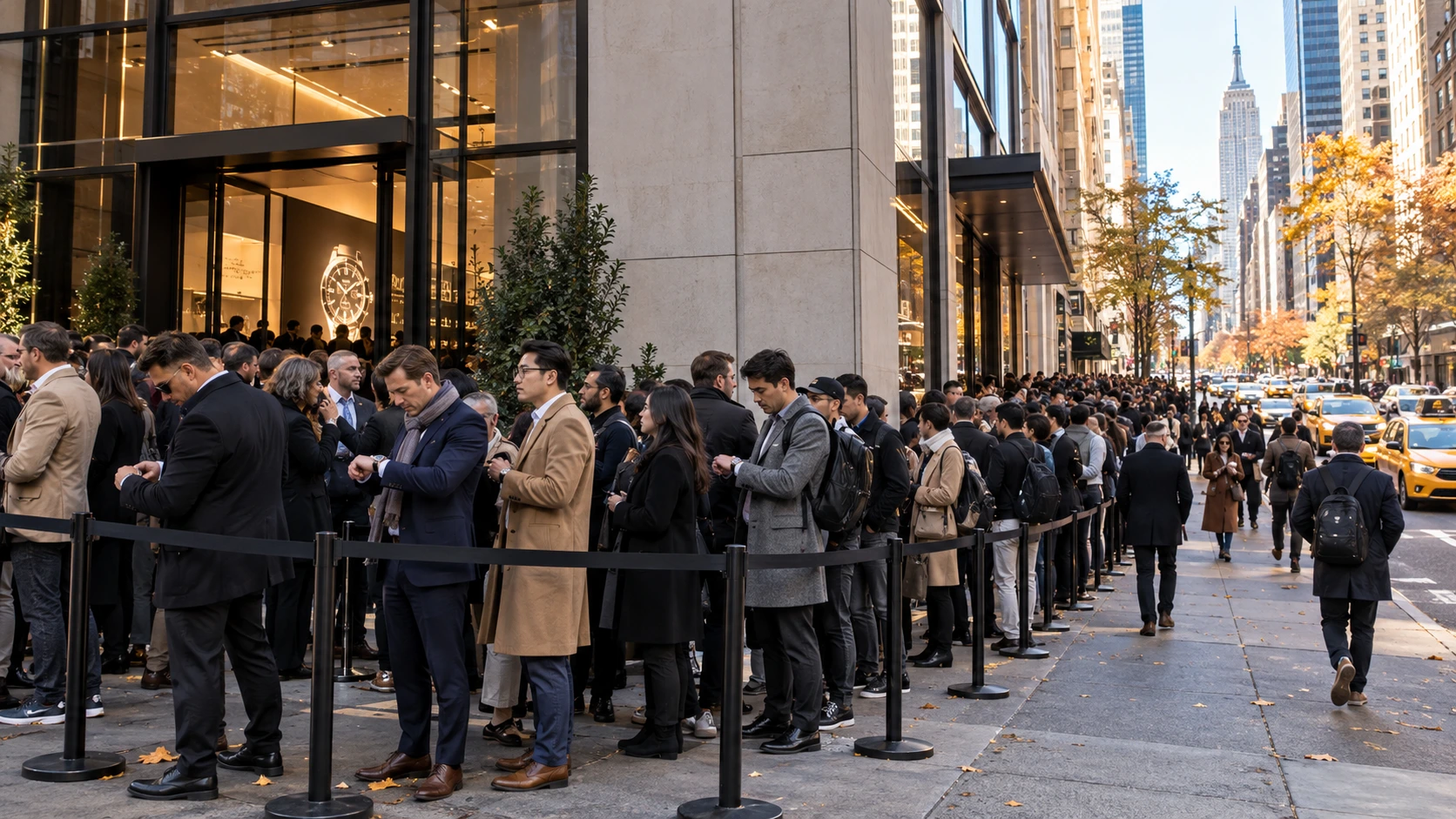
New York Watch Week 2026 ended with a scene that needed no official figures to attract attention. The queue to enter Windup Watch Fair stretched around an entire building in Midtown Manhattan, according to a recap published by Collective Horology on October 19, one day after the events concluded. Ironically, the problem was not a lack of interest but quite the opposite. One of the most accessible watch fairs now faces a question that had never been raised so urgently before: Can it remain free and open to everyone when the number of people wanting to attend exceeds the venue's capacity? Windup Watch Fair took place from October 16 to 18 at Center415 on Fifth Avenue in New York, bringing together more than 160 watch brands under one roof, compared with more than 140 brands in the 2025 edition. Admission was free, and visitors did not need to purchase tickets or register in advance. This approach has been central to the fair's philosophy since its inception, reflecting its ambition to make the watch experience equally accessible to experienced collectors and those exploring the world of watches for the first time. However, the growing success of this model has begun to put pressure on the venue itself. In an episode recorded live from WatchTime New York and published on October 19, Collective Horology's Gabe Reilly and Blake Buettner discussed the Windup queue that wrapped around an entire building in Midtown Manhattan. They explicitly raised the question of whether New York Watch Week had outgrown its current organizational capacity. They also highlighted the dilemma facing Windup's organizers: whether to preserve free admission and unrestricted public access or introduce ticketing or capacity controls to reduce overcrowding. From 11,000 Visitors to an Even Larger Fair Previous attendance figures help explain how the event reached this point. According to Worn & Wound, the organizer of Windup, more than 11,000 visitors attended the 2025 New York edition over three days, with more than 140 brands participating. That figure had already established the event as one of the world's largest watch fairs open to the public. When the fair returned in 2026, the organizers did not scale it back. Instead, they added another hall inside Center415 and increased the number of participating brands to more than 160. A verified final attendance figure for the 2026 edition is not yet available. It would therefore be inaccurate to claim that the event set a new attendance record before the organizers release their official figures. Nevertheless, the queues observed throughout the weekend, together with attendee accounts and analysis published after the fair concluded, clearly indicate mounting pressure on the venue. Discussions among watch collectors who attended the event suggest that waiting times reached approximately an hour and a half during certain periods. However, these are individual accounts rather than official data, making them more useful for understanding the visitor experience than as a definitive measure of attendance. Why Has Windup Become So Crowded? Part of the answer lies in the fair's operating model. Unlike many traditional luxury watch events, visitors do not need an invitation, a private appointment, or even advance registration. Anyone can arrive at Center415, enter free of charge, try on watches, and speak directly with brand founders, designers, and watchmakers. This is an experience that can be difficult to obtain in retail stores, particularly when dealing with small independent brands that lack extensive retail networks. The composition of the exhibitor list has also changed. Windup is no longer a limited gathering of what are commonly known as microbrands. Instead, it now brings together a broad spectrum of participants, ranging from small brands producing only limited quantities of watches to internationally recognized names such as Oris, Bulova, Christopher Ward, and Bremont. This mix allows visitors to move within a few hours between watches priced in the hundreds of dollars and more specialized and technically complex products, without the traditional separation between mid-market exhibitions and highly exclusive luxury events. At this year's New York edition, some booths were transformed into experiences inspired by the city itself. Brew created a space inspired by New York's yellow taxis and introduced the Metric Chrono Taxi edition, while Bulova presented a booth evoking New York subway cars. Collective Horology highlighted these examples as part of the fair's evolution from rows of tables displaying products into an event designed to create a complete experience around watches. WatchTime New York Succeeds with a Different Model Meanwhile, a short distance away in Manhattan, WatchTime New York offered a different illustration of what a successful watch fair can look like. Held at Gotham Hall during the same period, the event focused on luxury watches and independent watchmakers operating in higher price segments. Its eleventh edition brought together approximately 48 brands, according to the final program and coverage published before the opening. Participants included MB&F, Kari Voutilainen, Urwerk, Ressence, Czapek, Armin Strom, and Daniel Roth. However, its admission model was entirely different. WatchTime New York relied on paid tickets and limited capacity. Tickets for Friday evening's opening reception sold out, as did all tickets for Saturday, according to the event's official website, while Sunday tickets remained available for a longer period. Some panel discussions were limited to just 100 seats, giving organizers greater control over attendance inside the venue, although this made the event less accessible than Windup's free-admission model. This is where the contrast becomes particularly clear. The success of both events does not mean that one model is necessarily better than the other. Instead, it demonstrates that the American watch industry now has an audience capable of supporting multiple formats simultaneously: a large, free fair that welcomes everyone, and a smaller, more focused event built around ticketed admission and direct encounters with leading watchmakers and executives. New York Watch Week Is Not a Single Fair It is also important to recognize that New York Watch Week is not the name of a unified exhibition managed by a single organization. Rather, it is an informal description of several events taking place across the city during the same period. Alongside Windup and WatchTime New York, those days featured events such as Indies.NYC and The Hype, as well as private presentations at retailers and collectors' clubs, auctions, and previews of rare timepieces. As a result, visiting New York during this period became more like following a citywide program than attending a single event inside one convention center. Worn & Wound says it has coordinated Windup's dates with WatchTime New York for years. This year, however, it went further by connecting programming and highlighting other events taking place across the city. WATCHPRO described the result as a watch week created organically by its participants rather than formally announced by a central organization. This may also explain why the audience is no longer as locally concentrated as it was in the early years. Collective Horology believes the event has evolved from a gathering dominated by collectors from New York and neighboring states into one that attracts visitors from across the United States. This transformation coincides with the growing importance of the American market to the Swiss watch industry. The United States Has Become a Market That Cannot Be Ignored The expansion of New York Watch Week is not taking place in isolation from broader changes in the global watch industry. In recent years, the United States has become the largest export market for Swiss watches, while some European and Asian markets have experienced slowdowns or declines. As a result, meeting American collectors directly has become increasingly important for watch brands, particularly independent manufacturers that lack extensive retail networks and need to build trust with potential buyers through personal interaction. Collective Horology linked the growth of New York Watch Week to this wider context, describing the event's transition from a regional gathering into a nationally significant occasion. The fairs themselves have also become part of the purchasing decision. A collector considering a watch from a small independent brand may be unable to find it at a nearby retailer or try it on before spending thousands of dollars online. These events, however, provide an opportunity to compare dozens of products in a single day and speak with the person who designed the watch or founded the company. This is an experience that cannot be fully replicated through e-commerce or digital content. When a Fair's Success Becomes an Organizational Challenge The question left by the 2026 edition is therefore not whether audiences remain interested in watch fairs. The strong turnout provides a clear answer to that. Rather, the question is how to preserve the qualities that made Windup successful in the first place as the event continues to grow. Introducing paid tickets could reduce queues and give organizers greater control over capacity, but it would fundamentally alter the "A Watch Fair For Everyone" philosophy on which the event was built. Continuing to offer unrestricted admission, meanwhile, would preserve accessibility but could make waiting outside the venue an unavoidable part of the experience. The solution may not lie in ticketing alone. Organizers could consider larger venues, designated entry times, or a free registration system that distributes attendance more evenly throughout the day. Yet any such change would introduce an additional layer of organization to an event whose success was originally rooted in its simplicity: visitors could simply arrive at the door and walk in. This is the paradox that makes the story of Windup Watch Fair 2026 about much more than a queue on a New York street. Public watch fairs originally emerged as more approachable and flexible alternatives to large commercial trade shows. Yet some are now confronting the same challenge that major events faced before them: how to accommodate growing numbers of brands and visitors without losing the qualities that made people want to attend in the first place. Final attendance figures for the 2026 New York edition have not yet been released, making it impossible to measure the scale of its growth with precision. Nevertheless, the participation of more than 160 brands at Windup, sold-out tickets for major portions of WatchTime New York, and a queue stretching around an entire building all indicate that the question is no longer whether New York can establish an important watch week. Instead, it is how the city and event organizers will manage a level of success that is beginning to exceed the spaces originally designed to accommodate it.
A Queue Stretching Around an Entire Building in New York… Have Watch Fairs Outgrown Their Capacity to Accommodate Visitors?
WATCHOUT Team
Comments
No comments yet.