

German brand Sternglas marked its tenth anniversary in a way that echoes how it built its audience from the very beginning. Rather than keeping the design process within its own team, it brought around 5,000 members of its community into the development of its new anniversary watch, the Zirkel X, drawing on their opinions before arriving at the final design. According to Fratello, these people were not simply an audience that received the finished product; they contributed their views during development, and the brand describes them as the "inner circle" of its community.
The story goes beyond a new release celebrating a watch brand's founding. The more interesting question is whether a brand's customer community can itself become part of product development — and where its contribution ends and the designer's decision begins. In an industry traditionally built on the names of designers and watchmakers and on the vision of the house, Sternglas offers a more open model, in which the public's opinion enters the process early instead of appearing only after the watch reaches the market.
5,000 people who didn't sit at the design table
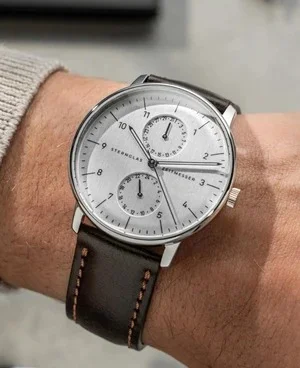
Describing the project as "a watch designed by 5,000 people" would be an exaggeration. Thousands of participants did not pick up pencils to draw the watch, and the design process did not turn into a popular vote on every detail. But Fratello confirms that the views of around 5,000 active members of the Sternglas community fed into the development of the Zirkel X, and that the brand took their preferences and feedback into account when shaping the final product.
The distinction matters, because participatory design does not necessarily mean handing the decision to the public; it means using the public as a source of information before the decision is made. The designer remains responsible for the result, but instead of guessing what customers prefer, they can test certain options with a community that already knows the brand and has experience with its products.
This is not the first time Sternglas has used this approach. For the Zirkel Edition Bauhaus several years ago, the brand enlisted around 1,500 members of its audience and presented them with five different designs to gather their reactions before developing the final version. The jump from 1,500 to 5,000 participants on the new project shows that community involvement is no longer a side experiment for the company, but part of how it works.
A brand that started with an online audience
There is a reason this approach comes more naturally to Sternglas than to many traditional houses. The brand did not start with a luxury boutique or a decades-old retail network; it emerged in Hamburg in 2016, when founder Dustin Fontaine launched its first watch on the crowdfunding platform Kickstarter. The campaign raised around €16,000 to produce the first batch, so the public was part of the brand's birth before later becoming part of the development of some of its watches.
The company now says its wider community includes more than 53,000 watch enthusiasts, while its products are sold through more than 550 retailers alongside its direct online sales. This makes clear that the 5,000 participants in the Zirkel X's development do not represent its entire audience, but a more active segment of it.
This background makes the new watch feel like a celebration of how the company itself grew. The crowdfunding platform that helped launch the brand ten years ago is built on the idea of the public joining a product's journey early, and Sternglas is now reapplying that logic after moving from a start-up to a brand sold in hundreds of stores.
What came out of this collaboration?
The result is the Zirkel X, a 38mm stainless steel watch with a vertically brushed silver dial and two sub-dials aligned on a single axis: the date at 12 o'clock and a 24-hour indicator at 6 o'clock. The name Zirkel — German for "circle" — is reflected in how the design is built around circular forms and symmetry between the dial's elements.
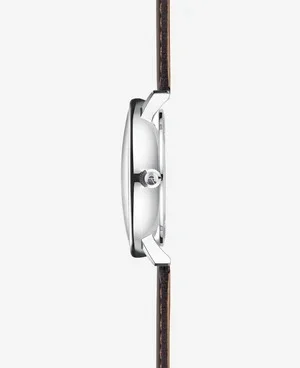
The brand also used the Neue DIN typeface for the first time, an evolution of the DIN font associated with German technical standards and signage, with larger numerals for improved legibility. These details keep the watch within the visual language Sternglas has used since its founding, influenced by Bauhaus principles of clarity, geometry and stripping away the unnecessary.
This highlights an important point about participatory design: the watch does not look like a product that tried to please 5,000 different tastes and ended up with no personality. On the contrary, it is still instantly recognisable as a Sternglas, which means the community's role did not erase the identity of the designer or the brand.
Quartz instead of a mechanical movement
Although anniversary pieces in watchmaking are often associated with mechanical movements, Sternglas chose the Miyota 6P23 quartz movement. It offers the date and a 24-hour indicator, with a stated accuracy of ±20 seconds per month and a battery life of up to three years. The watch is officially priced at €299.
The choice fits the brand's philosophy better than it might first appear. Sternglas did not build its name on complicated movements or on competing in high-priced luxury watches, but on clear German design at an accessible price. So its anniversary watch did not need a tourbillon or a new movement to tell its story; what is unusual here is the way it was developed.
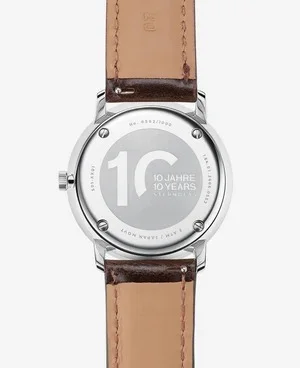
The Zirkel X is also not a limited edition in the traditional sense. Only the first batch of 1,000 watches carries the tenth-anniversary engraving on the caseback; after that, the model will continue in the collection without the commemorative engraving.
When the customer goes from buyer to participant
The broader idea behind the project goes beyond Sternglas. Digital communities have given brands access to something that was not easily available a few years ago: a large group of engaged customers who can be consulted and with whom product ideas can be tested before production begins.
On the other hand, the approach carries an obvious risk. If every detail of a product becomes the outcome of a vote, a brand may end up with a safe design that pleases as many people as possible but lacks a strong character. Design sometimes requires a decision that does not command consensus, especially in an industry that relies on distinctiveness and visual identity.
That is why the Sternglas experiment is most interesting when read as using the public as a source of knowledge rather than a substitute for the designer. Thousands provide feedback and preferences, but the brand remains responsible for turning those scattered opinions into a single, coherent product.
From 1,500 participants to 5,000
Perhaps the most telling number in the story is not a Zirkel X specification, but the growth of the development community from around 1,500 people in an earlier project to 5,000 for the tenth-anniversary watch. A decade after crowdfunding its first product, the brand is using a larger community to test the direction it wants to take.
This puts the Zirkel X in a different position from an ordinary commemorative watch. It is not just a product bearing the number "10" or a caseback engraving celebrating a decade in business, but the result of a method Sternglas has used to make its audience part of its commercial story from the start.
The question the experiment leaves for the industry is bigger than the watch itself: if a relatively small brand can involve 5,000 customers in developing a real product without losing its identity, will involving communities of collectors and customers become a more common part of how watches are designed in the years ahead?
Comments
No comments yet.