
Here is the professional, accurate English translation of the article: From the Makkah Clock to German Watchmaking: Lang & Heyne Introduces a Special Edition for Saudi Arabia
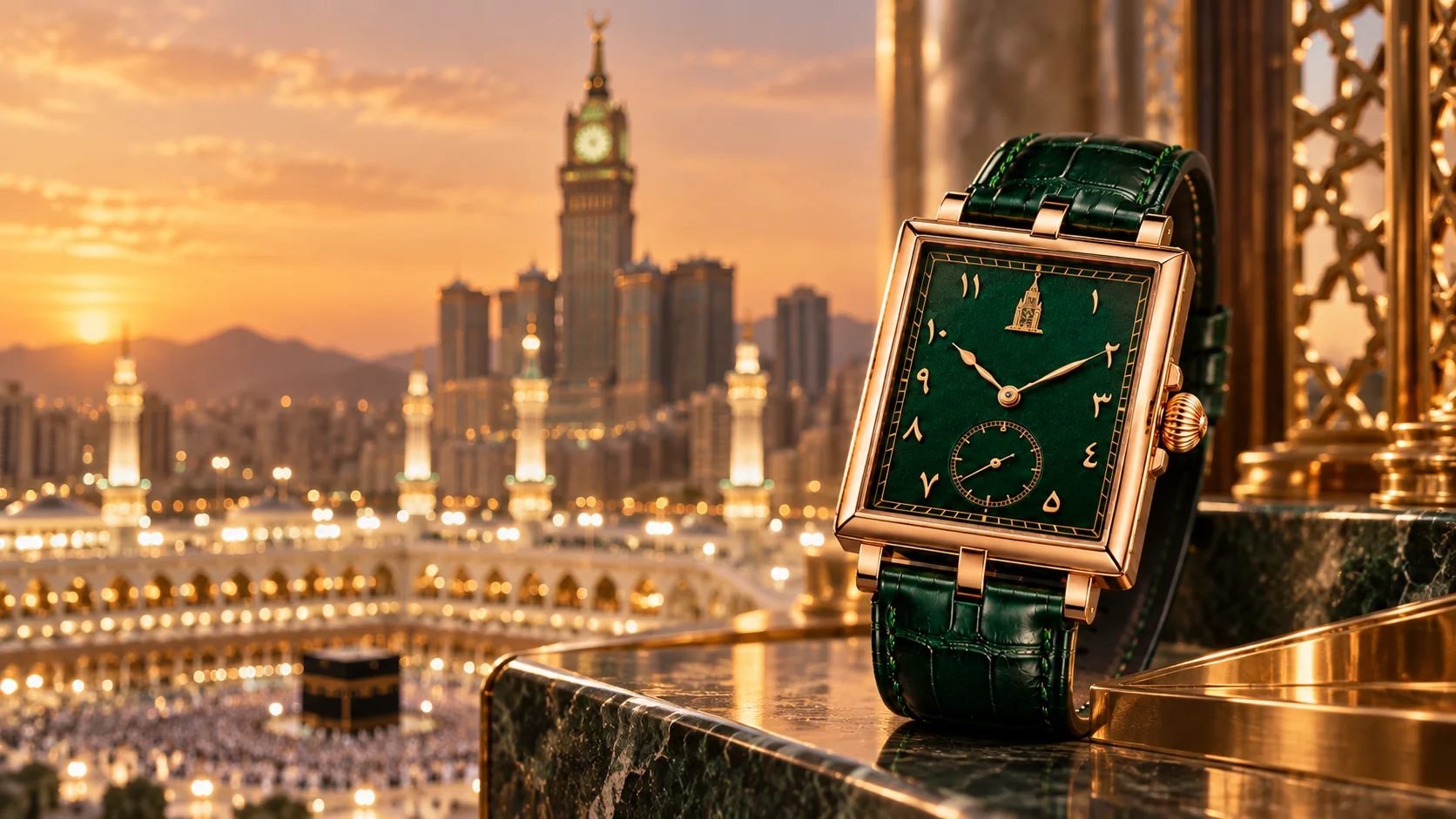
From one of the world's largest architectural timepieces to a mechanical watch merely a few centimeters wide, key design cues from the Makkah Clock have transitioned into a new edition introduced by the independent German manufacture Lang & Heyne. Unveiled among several bespoke watches for the Saudi market during "Timeology Nights" in Riyadh, the timepiece is dubbed the "Clock." It is based on the brand’s signature rectangular "Georg" model, reimagined with a royal green dial, Eastern Arabic numerals, and a distinct 12 o'clock index directly inspired by the 12 o'clock marker of the Makkah Clock.
The concept immediately commands attention due to the monumental contrast between the source of inspiration and the final wristwatch. The Makkah Clock features a dial measuring 43 meters in diameter, set atop a tower rising 601 meters high, whereas the standard Georg measures a modest 40 × 32 mm. Between these two vast scales, Lang & Heyne avoided creating a literal miniature of the tower, choosing instead to distill elements capable of living naturally on the wrist. How Does the Makkah Clock Become a Wristwatch?
In projects of this nature, the challenge lies not in finding an iconic symbol and applying it to a dial, but in determining how much can be translated without eroding the manufacture's own design identity. The Makkah Clock possesses an unmistakable visual presence—from its green hues and numerals to its ornamental motifs and surrounding architecture. Yet, the German edition deliberately avoided overcrowding these cues into a compact space.
Instead, the design relies on a refined set of references: a royal green dial, Eastern Arabic numerals, and an adapted 12 o'clock marker echoing the monumental tower clock. The fundamental architecture of the Georg remains intact, including its rectangular case and the classical display of hours, minutes, and an oversized subsidiary seconds dial below.
This balance allows the connection to Makkah to remain legible without turning the watch into a mere novelty or souvenir. The inspiration is unmistakable, yet Lang & Heyne’s design language never recedes into the background—a delicate equilibrium rarely achieved in regionally themed editions. Why Did Lang & Heyne Select the Georg?
From an architectural and mechanical perspective, the choice of the Georg is intuitive. The model stands out within the brand’s predominantly round portfolio due to its rectangular silhouette and clean contours. Lang & Heyne defines the Georg by its crisp geometric execution, defined bevels, and an expansive off-center seconds subdial. Standard dimensions measure 40 mm in length, 32 mm in width, and 9.4 mm in thickness.
This profile naturally aligns with the architectural essence of its monumental muse far better than a conventional round case. More crucially, it carries substantial mechanical merit: the manufacture developed the Caliber VIII specifically to match the rectangular architecture of the Georg, rather than casing a round movement within a rectangular frame. Consequently, the watch's geometric logic flows uninterrupted from the exterior to the interior.
This structural synergy elevates the project beyond a simple dial variation. Even if the Saudi edition preserves the core technical baseline of the Georg, the underlying reference was chosen because its external geometry and internal mechanical layout were already intrinsically linked. From 43 Meters to 32 Millimeters
The disparity in scale alone captures the essence of the narrative. According to Guinness World Records, the Makkah Clock boasts a 43-meter diameter, ranking among the largest permanent clock faces in the world, while the Georg measures just 32 mm across.
Their functional purposes are just as divergent. The former was engineered for monumental visibility across a holy city welcoming millions of pilgrims; the latter exists for intimate, personal timekeeping, requiring no more than a subtle flick of the wrist. Literal replication was impossible; reduction and nuance became the principal design tools.
In this sense, the "Clock" edition does not attempt to reconstruct the Makkah Clock. Instead, it isolates the essential visual signatures that make its face instantly recognizable and reinterprets them through the distinct vocabulary of high-end Saxon horology. A German Manufacture Defined by Low-Volume Craftsmanship
Lang & Heyne operates as an independent manufacture situated on the outskirts of Dresden, producing mechanical timepieces in exceptionally limited quantities. Its creations feature proprietary in-house calibers, elaborate hand-finishing, and deep roots in Saxon watchmaking traditions. Founded in Dresden in 2001, the manufacture names its core references after historical figures of Saxony, including Duke Georg.
This low-volume ethos makes bespoke projects a natural extension of the brand's philosophy rather than an exercise in mass commercialization. The manufacture frequently caters to niche collector communities and specific markets, having previously produced a 12-piece Georg limited edition with a Southeast Asian retailer and a 7-piece edition for South Korea.
Notably, translating a tower clock into a wristwatch is not an entirely novel exercise for Lang & Heyne. The manufacture previously drew inspiration from a historic tower clock in Glashütte, transferring its dial aesthetics into a hand-wound mechanical wristwatch. The Saudi edition applies that same design exercise to a monument vastly different in scale, cultural resonance, and visual weight. What Lies Inside the Georg?
The standard Georg is powered by the manual-wind LH Caliber VIII, purpose-built for the watch’s rectangular profile. The movement measures 34 × 26.5 mm with a height of 4.8 mm, beats at 18,000 vibrations per hour (2.5 Hz), and delivers a 55-hour power reserve. Comprising 160 components, 19 rubies, and one brilliant-cut diamond, it features hours, minutes, small seconds at 6 o'clock, and a hacking-seconds mechanism for precise synchronization.
A point of technical rigor must be maintained regarding the Saudi edition: while announcements confirm its foundation on the Georg and its Makkah Clock design cues, an independent technical specification sheet detailing whether the movement finishing, exact case dimensions, and materials mirror the standard reference identically has yet to be formally disclosed. The Caliber VIII baseline serves as the technical reference point until the manufacture releases comprehensive technical documentation for the Saudi edition.
Such precision matters in haute horlogerie, where low-volume editions frequently retain the base caliber while introducing bespoke finishing, unique engravings, distinct metallurgy, or structural nuances not evident at initial reveal. More Than an Architectural Landmark
Selecting the Makkah Clock as a muse carries singular weight in a story fundamentally about horology. The Makkah Royal Clock Tower stands 601 meters tall with four 43-meter faces, placing it at the absolute opposite extreme of the timekeeping spectrum from a boutique atelier hand-finishing mechanical wristwatches.
Furthermore, the monument deepened its horological legacy in 2026, when the Clock Tower Museum was recognized as the highest museum within a building, situated at an altitude of 426.875 meters. Showcasing the history of timekeeping, astronomical measurements, and clockwork mechanics, the tower transcends its architectural utility to serve as a cultural repository for the science of time.
Consequently, Lang & Heyne’s inspiration differs fundamentally from adopting a famous monument purely for commercial visibility. The source is inherently a clock, and the final creation is a watch—bridging the chasm between monumental civil engineering and microscopic fine watchmaking. What Makes a Saudi-Specific Edition Succeed?
The "Clock" emerged among 24 bespoke and limited editions unveiled in Riyadh, each interpreting a different facet of Saudi heritage. Some watches explored native materials; others referenced Sadu weaving, AlUla, or the kingdom's mining history. Lang & Heyne chose one of the nation's most prominent symbols of time measurement.
This diverse landscape sets a higher bar than artificial scarcity. Labeling a watch a "Saudi Special Edition" is insufficient on its own, and a green dial combined with Eastern Arabic numerals can easily become a predictable formula absent clear design intent. In the case of the "Clock," the cohesion stems from three elements: a muse rooted specifically in timekeeping, a German rectangular canvas mechanically tailored to that geometry, and restrained modifications that preserve the identities of both the subject and the manufacture.
Key details remain forthcoming—including exact production numbers, retail pricing, case alloys, and final movement execution. Yet the core thesis is evident from the outset: Lang & Heyne did not merely mount the Makkah Clock on a strap. It extracted what could legitimately function within the grammar of fine watchmaking, translating it onto a German platform whose mechanical and architectural integrity had been established years prior.
This thoughtful integration makes the timepiece compelling. The dialogue between Saudi culture and global haute horlogerie becomes far more persuasive when it avoids superficial emblem-grafting, choosing instead to let the cultural touchstone serve as the conceptual foundation for a design coherent before its story is even told.
Comments
No comments yet.